
“Merry Christmas, Mr. Lawrence” is an extremely peculiar film. The 1983 World War II flic is probably best remembered for the musician-turned-actor who starred in it: David Bowie. However, the movie features another multi-talented artist opposite Bowie, Ryuichi Sakamoto, who was not only an actor but also the sole composer of the film’s soundtrack. Though Bowie, fresh off the release of Let’s Dance, was certainly the greater draw for international audiences, Ryuichi Sakamoto was an equally revered figure in his home nation. When the Japanese composer sadly passed away in 2023, his death failed to make waves internationally as Bowie’s had seven years prior. In death, Sakamoto is unlikely to receive the recognition he deserves outside Japan.
The two cultural titans were joined in the project by another influential figure: David Sylvian, frontman of the then recently broken up New Romantic band Japan. While Sylvian didn’t act or compose, he did provide the lyrics and vocals for the score’s main theme. This collaboration between Sakamoto and Sylvian began before the production and would far outlast it. Japan – as hinted at by their name – was a band fascinated by Eastern musical tradition, which they explored extensively in their work. The group saw great success in Japan, which brought Sylvian and Sakamoto into contact. Ultimately, it is Sakamoto’s partnership with Sylvian that introduced the composer to Western audiences and is perhaps what he is best remembered for abroad.
The life and work of Ryuichi Sakamoto merits greater attention. Let’s look back at his genre-transcending contributions to electronic, classical, and avant-garde music – and his collaboration with the similarly underappreciated artist David Sylvian.
The Music Major
Ryuichi Sakamoto began his career in 1975, while studying music composition at Tokyo University of the Arts. He completed his master’s degree in 1976, with a concentration on electronic and ethnic music. Sakamoto was fascinated by world music traditions, so much so that he planned on pursuing a career as an ethnomusicologist – someone who studies music as a social and cultural practice. However, the growing potential of his other interest, electronic music, took his sights away from a career in academia.
The mid-1970s was a turning point in the development of synthesizer technology. The American-made synthesizers that had dominated the market up to that point, like the legendary Minimoog and ARP 2600, retailed for upwards of $10,000 in today’s money, making them accessible to already proven artists. Young, working-class musicians simply couldn’t break into the economically deterring world of electronic music. However, Sakamoto’s elite education made him an in-demand session musician and arranger at Tokyo studios, placing him in close proximity to these costly instruments.
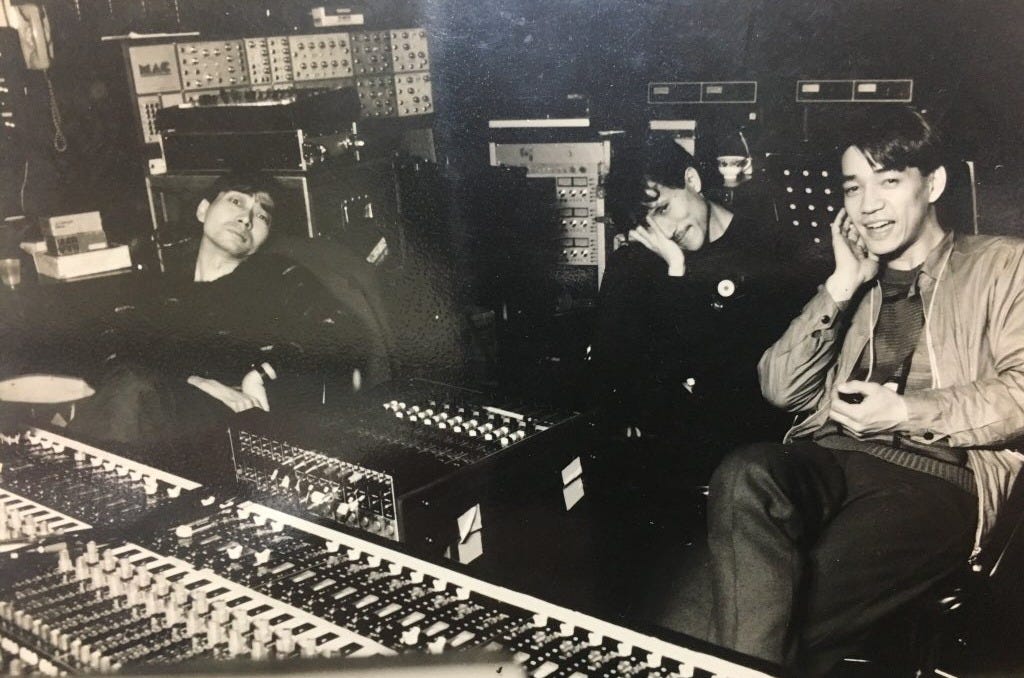
In 1978, Sakamoto along with fellow session musicians Haruomi Hosono and Yukihiro Takahashi formed Yellow Magic Orchestra. The band’s name was a satire of the Western concept of “white magic” – supernatural powers used for good – and “black magic” – powers used for evil, which together formed a racially charged dichotomy. Yellow magic represented Western stereotypes of Asian exotism, which the band sought to co-opt and redefine with their brand of cutting-edge electronic music.
A German Influence
The sound YMO pioneered wasn’t conjured from thin air; it owed a great debt to the pioneering work of a certain West German band – arguably the most influential electronic act ever: Kraftwerk. The group formed in Düsseldorf in 1970 originally amid the rise of Krautrock, a genre of experimental rock that blended psychedelia with electronic textures to create a hypnotic, minimalist sound. Kraftwerk increasingly emphasized the electronic element of Krautrock as time went on, and in 1974 the band released their landmark album Autobahn, whose eponymous track is a bewildering 23-minute symphony of layered synthesizers and drum machines – with a touch of acoustic instrumentation from violin and flute. The album and its lead single were Kraftwerk’s first hit, both at home and abroad. It reached No. 25 in the US1 and No. 11 in UK,2 introducing the two nations to an entirely new genre of music: synthpop.

Kraftwerk’s blueprint for electronic music is cold and robotic; the synths have simple, rigid beats, accompanied by dryly delivered vocals. The sheer originality of the band’s sound made them come across as inextricably futuristic, a label they embraced and used to foretell an uneasy future of vast technological advancement. This, of course, only further played into the common stereotype of the serious German – a caricature similarly pervasive for the Japanese. Building on Kraftwerk’s demonstration that synthesizers could make melodic, commercially successful pop, YMO took electronic music in an entirely different direction: a high-energy, whimsical array of intricately arranged synths.
A Thousand Knives
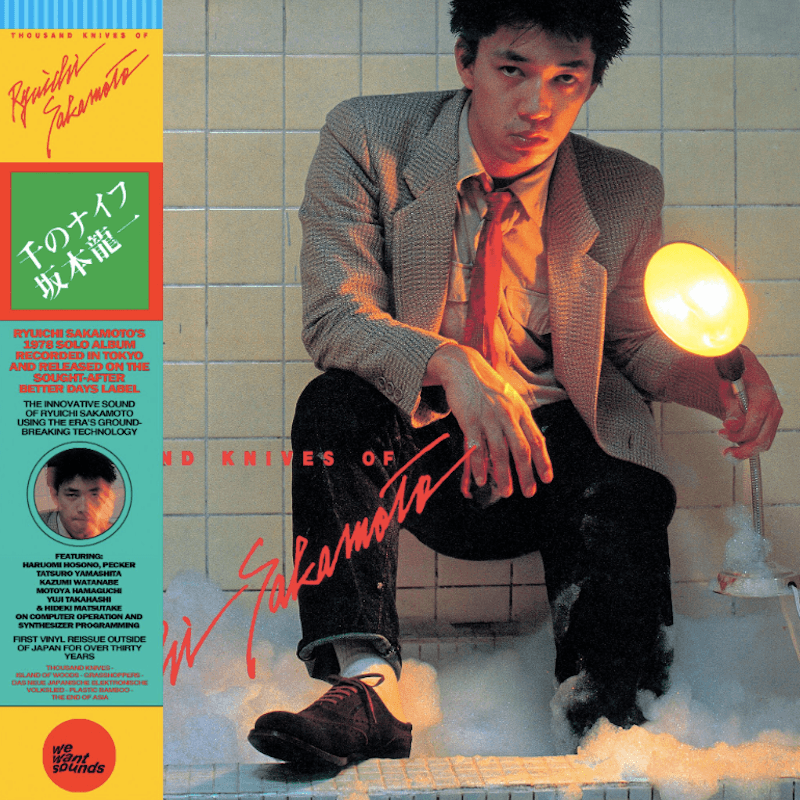
1978 would prove to be a momentous year for Ryuichi Sakamoto, which saw the release of two debut albums: first, his solo effort Thousand Knives of Ryuichi Sakamoto, and later, YMO’s self-titled record.
Thousand Knives shows the degree of influence Kraftwerk had on every budding electronic musician that came after, regardless of what corner of the world they called home. The whole album feels like Kraftwerk – but on coke. Sakamoto certainly sought a warmer sound than his German mentors, but tinges of grim technological automation remain.
The leadoff track “Thousand Knives” is the record’s standout. Clocking in at over nine minutes, the song begins with over ninety seconds of a lone, eerie vocoder vocal – which is actually Sakamoto reciting a poem by Mao Zedong3 – before launching into a lush, reggae-inspired electronic instrumental, complete with a water droplet beat. The keyboard solos spaced throughout the track allow Sakamoto to seamlessly swing between a cheery and more sinister tone. The extended electric guitar solo beginning just past the four-minute-mark is the highpoint and powers the song through its intense conclusion. Featuring guitar so prominently in a synthpop track was an entirely novel concept in 1978, when electronic music was still seen as the antithesis of rock. Sakamoto proved that the two could coexist, the former creating the atmosphere and latter bringing the passion. This melding of electronic and traditional instruments would inspire bands like New Order – who would go on to master the craft.
The remainder of the album shows the versality of a synthesizer-driven production, combining many disparate sounds. On “Island of Woods,” Sakamoto creates an unsettling atmosphere by heavily sampling forest sounds and layering orchestra-like synth instrumentation above it. “Grasshoppers” – perhaps foreshadowing its composer’s future creative direction – is a modern classical piano piece and features no electronic instruments until its final minute. The album closer, “The End of Asia,” is an ode to Eastern music tradition made modern, with glossy synths and guitar placed against a woody marimba. Sakamoto rounds out the record with a second allusion to Mao by slipping “The East is Red,” China’s Cultural Revolution-era national anthem, stealthily into the song’s coda.4
Thousand Knives is an incredibly ambitious debut made even more impressive by the equally excellent album Sakamoto’s band released the following month. Juxtaposing the two works gives a strong indication of the creative role he occupied in YMO. While the arrangements are similarly virtuosic, Sakamoto’s solo material strikes a more serious tone, offering a more pensive exploration at the genre’s frontier.
Dynamite Debut
YMO’s release was originally intended to be a one off, hence the eponymous title. However, the success of a single containing a mashup of the tracks, “Computer Game” and “Firecracker,” internationally – peaking at No. 17 in the UK5 and No. 60 in the US6 – as well as the album’s moderate success in Japan spurred the members to make the partnership a permanent one. The record has an incredibly playful sound that is achieved in part through sampling sounds from the massively popular video game Space Invaders, along with Circus and Gun Fight. Consequently, the surprise global success of “Firecracker” can heavily be attributed to the novelty value of its lead-in track, “Computer Game.”
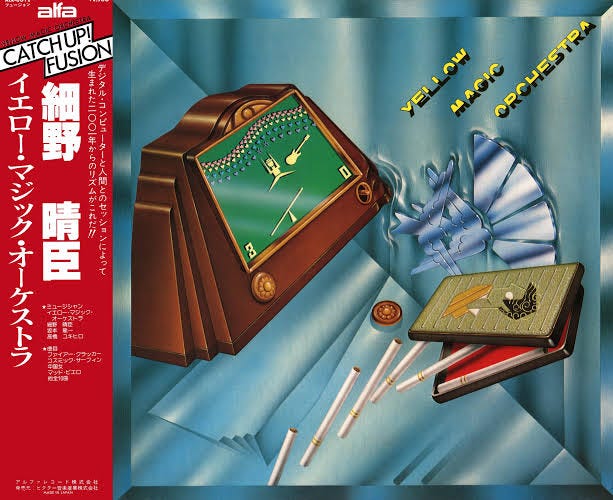
“Firecracker” is a cover of a little-remembered 1959 tune by American composer Martin Denny. The song was born out of the exotica craze of the 1950s and ‘60s, where insincere, easy-listening interpretations of world music backed with orchestral instrumentation were extremely popular in the US. YMO, as denoted by the “Yellow Magic,” approached exotica with a mix of curiosity and rebuke, bringing the explicit Orientalism of “Firecracker” to new heights in their lush, fanciful electronic reimagining. With this track, YMO took back an “Asian” song that was neither made by nor for Asians.
Another standout moment of the record is the sixth track, “Tong Poo,” which is Chinese for “east wind.” The track was written by Sakamoto, and unsurprisingly, considering its title, leans heavily into its “Asianness,” which is complemented by elements of American funk and disco. This novel blend of electronic and funk displayed throughout the album was incredibly influential in the then-emerging New York hip-hop and Detroit techno scenes. This was so much the case that in November 1980 YMO performed on the legendary African American musical variety show Soul Train, making them the first – and only – Japanese band to ever do so.7
Like Kraftwerk, YMO transports the listener towards a hi-tech future with their debut, but in this case, dancing and having fun – as well as making a pointed societal critique –take center stage rather than grim themes of automation, efficiency and productivity. With the success of their first album behind them, YMO sought to expand their creative horizons and move above their status as a jovial, novelty act.
Solid State Survivor
With YMO’s follow-up album Solid State Survivor, released the following September, the band took their songcraft to new heights – and their popularity as well. The record soared to No. 1 in Japan and stayed on the Oricon LP Chart for a staggering 82 weeks, making it the best-selling album of 1980.8 Internationally, the album didn’t match the fanfare of their debut; however, this was due to the band embracing a quintessentially modern Japanese sound over their prior mockery of Western novelty, rather than a sign of creative decline.
Solid State Survivor shows much greater resemblance to the extravagant synth dance music that would come to define the 1980s than the genre’s Krautrock roots. YMO recorded the album in the spring of 1979, which coincided with Disco’s absolute peak popularity and the rise of the New Wave – a pop-oriented outgrowth of punk rock. Solid State Survivor’s energetic funk-fused techno sound is largely the result of this overlap.
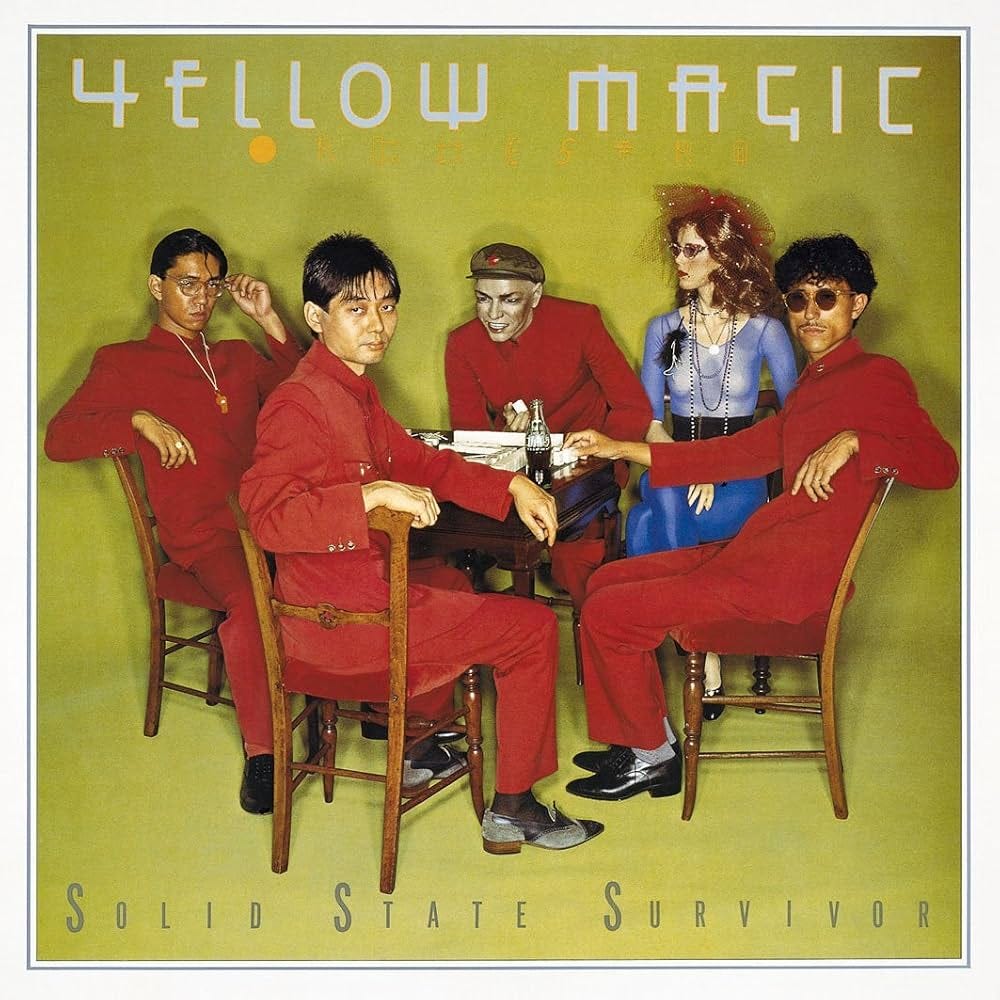
Like their debut, YMO’s sophomore effort favors instrumentals over a traditional pop song structure. The first side of the record is predominantly instrumental, while the second side uses a vocoder to heavily obscure most of the vocals – besides on a half-baked cover of The Beatles’ “Day Tripper” where, regrettably, they are crystal clear. In a testament to just how cutting-edge Solid State Survivor was, more than several of the album’s tracks with the addition of lyrics could fit seamlessly into the discographies of later British New Wave bands – like Depeche Mode, The Human League, and Japan. It was only the art school sensibilities of the members of YMO that prevented them from fully embracing the commercial potential of synthpop before the Brits.
Two standout tracks on the album, “Technopolis” and “Rydeen,” are masterpieces of Japanese techno and mark the next echelon of synthesizer arrangement. Layers of metallic keyboards float above rapid, bouncy basslines with sampled computerized sounds throughout. “Castalia,” a Sakamoto-written track, is the complete opposite: featuring an unsettling, ambient synth coupled with a traditional piano melody; its placement after the feverish “Rydeen” makes for an extra jarring transition. The song marked Sakamoto’s first mixing of synthesizers and classical instrumentation in a meaningful way. “Castalia” would form a blueprint for David Sylvian’s ambitious redirection of his devotedly New Wave group Japan – which we will discuss in detail later.
A final track of note, “Behind the Mask,” another Sakamoto composition, trades away the rocket fuel of “Technopolis” and “Rydeen,” and the dreamlike atmosphere of “Castalia,” preferring to land somewhere in the middle: a relaxed, hypnotic pop song. Interestingly, the song isn’t very well remembered for its appearance on Solid State Survivor, but instead for the list of legendary musicians who clamored to record their own versions years later. One such version was recorded in 1982 and was slated to appear on a studio album but had to be scrapped when a royalty agreement with YMO’s label could not be reached. The artist was Michael Jackson, and in some alternate reality, a Yellow Magic Orchestra song was featured on the best-selling album of all time: Thriller.9
Regrettably, the unexpected success of YMO’s first album in the West, and the cultural phenomenon that their second album sparked in Japan, failed to be replicated with their subsequent albums. Their third album BGM was released in 1981 to generally positive reviews but was recorded under incredibly contentious circumstances. Sakamoto found himself at constant odds with Haruomi Hosono, the group leader, over YMO’s bright, orientalist sound – which he felt had run its course. Sakamoto was still a music student – not a popstar – at heart and wanted to feature more of his classical compositions on YMO albums, but this was met with a tepid response from the other two members. Of course, the composers had never been hesitant to pave his own path before; so, as Yellow Magic Orchestra faltered and officially disbanded in 1984, Sakamoto steered his solo career in a new direction. He would find company in another electronic artist looking to make a change: David Sylvian.
Visions of China
By 1980, Japan had recorded four studio albums, ranging in style from glam rock to ambient art pop. Their most recent album, Gentleman Take Polaroids, featured their first collaboration with Ryuichi Sakamoto, who the band had recently met while touring their namesake nation; he subsequently provided keyboards on the track “Taking Islands in Africa,” which could entirely be mistaken for a YMO song.
Just as YMO modelled their early career off musicians halfway across the world, Japan did so too, selecting the legendary early ‘70s proto-punk band the New York Dolls. Brothers David and Stephen Bett took their stage names as tribute to Dolls’ guitarist Sylvian Sylvian and lead singer David Johanssen – becoming David Sylvian and Steve Jansen.
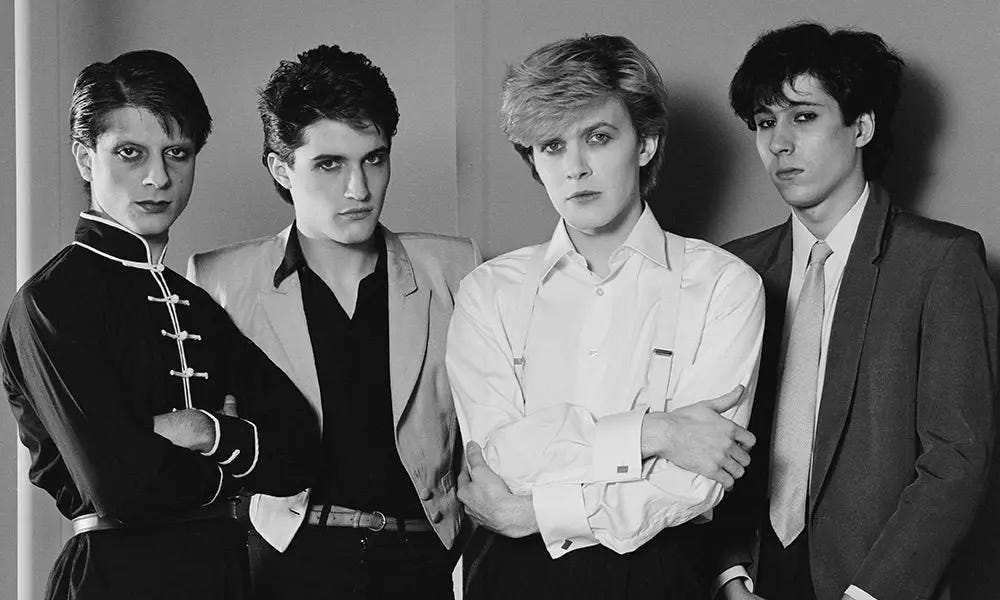
As their careers progressed, Japan gradually transformed from David Bowie glam rock wannabes to a group operating on the avant-garde frontier of New Wave, an umbrella for any punk-inspired British band at the time. Their turn towards experimentalism coincided with an interest in Chinese musical tradition. This may seem rich considering the “Japan” name; though, in actuality, it was chosen at random after finding a travel brochure on the floor of the bus on their way to their first gig.10
Japan released their landmark fifth and final studio album Tin Drum in November 1981, which – best exemplified by its cover art – goes to great lengths to show the extent of the Oriental influence. Of course, over four decades after its release, the sincerity of Tin Drum’s cooption of Chinese music can be rigorously questioned – as it was in a 2019 academic journal article by Runchao Liu.11 However, any claim of cultural appropriation must be weighed the thoughtfulness of this album, which far exceeds just about any other Asian-inspired work by a Western band.
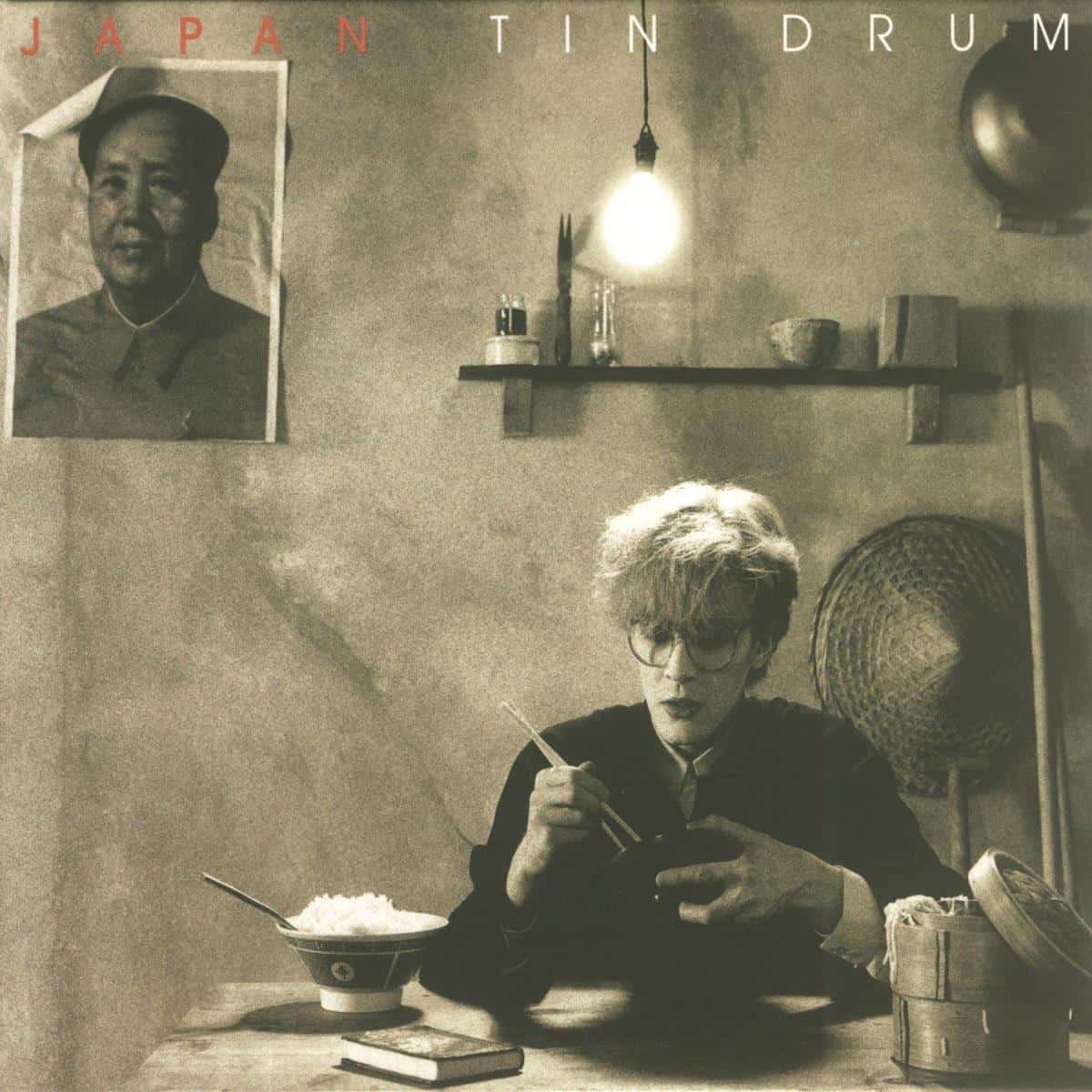
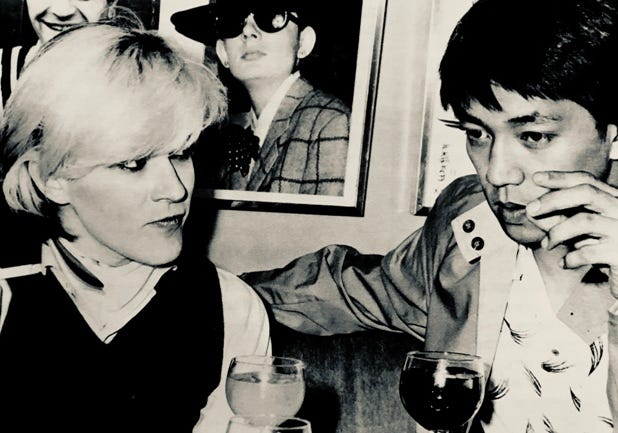
Ryuichi Sakamoto’s friendship with Sylvian and the rest of Japan was no doubt the driving force that compelled them to fully commit to the Eastern aesthetic on Tin Drum. As you may recall from Sakamoto’s solo debut, he held a deep fascination with Chinese history and politics – which compelled him to sprinkle in a variety of Mao Zedong references on the record. Japan similarly elected to frame Tin Drum as a meditation on Chinese life post-Cultural Revolution. The band immersed themselves in Chinese traditional as they wrote the album,12 trying to emulate the sparse, atmospheric sound of acoustic instruments on synthesizers.
The majority of the album’s tracks, including “Canton,” “Visions of China,” “Sons of Pioneers,” and the slightly redundant “Cantonese Boy,” address their Eastern inspiration head-on. However, Tin Drum’s third single – and by far the finest song Japan ever wrote – “Ghosts,” is an outlier. Though the track shares the minimalist aesthetic of Chinese musical tradition, it owes greater credit to the work of avant-garde German composer Karlheinz Stockhausen. “Ghosts” is primarily silence, interspaced with a variety of synthesized keys and drums that are scarcely layered. Sylvian’s vocals have a detached, haunting delivery and effectively are the only constant instrumentation throughout. Miraculously, the song was a surprise hit that went to No. 5 in the UK13 – the band’s highest charting single to date and one of the most unlikely mainstream hits in British history.
If the measure of sincerity is whether the motifs of one culture is being exploited for commercial gain in another, then Japan fails this test – Tin Drum remains their most famous and best-selling record to date. However, it can also be confidently asserted that this success was as much of a surprise to Sylvian and company as anyone. A forty-minute meditation on Chinese music and history was as a sure-fire pop chart topper then as it is today – which is to say, little to none. A looser, more comedic interpretation of “Asian music,” such as the massively successful 1980 single “Turning Japanese” by New Wave one-hit-wonders The Vapors, was a legitimate pathway to commercial success at the time. The song, which was constructed around an oriental lick, peaked at No. 3 on the UK chart.14 Ultimately, with this final point in mind, it was Japan’s commitment to creating a truly inspired reimagining of the Far East, rather than relying on tired tropes that many of their contemporaries fell victim to, that allows Tin Drum to withstand the test of time as an intact creative triumph.
Bamboo Music
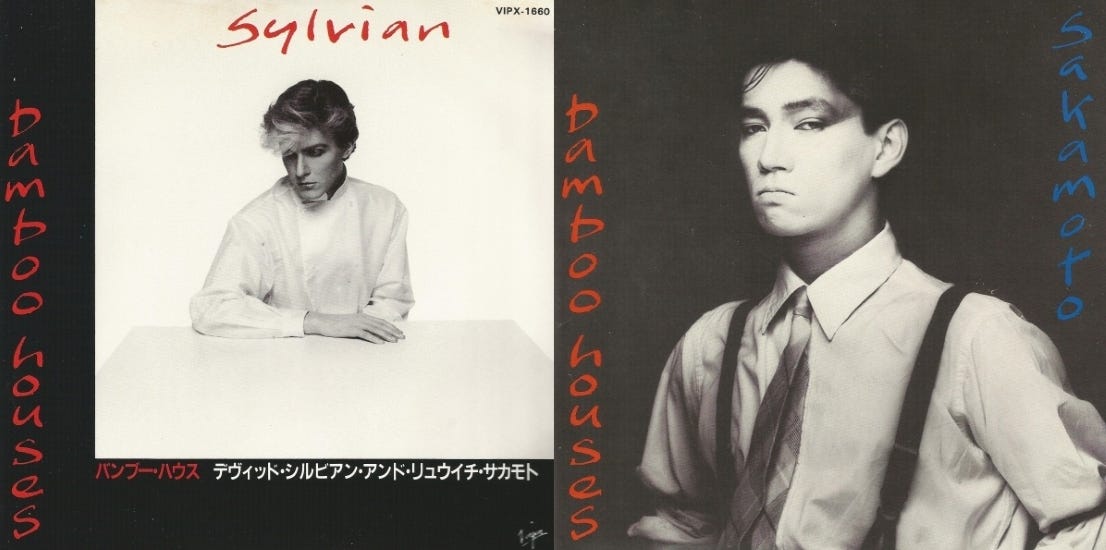
With YMO and Japan having run their courses, though both still technically together, Ryuichi Sakamoto and David Sylvian entered the studio in early 1982 to record what would become their first single together, “Bamboo Houses,” which Sylvian sang and for which Sakamoto provided spoken-word vocals for in Japanese. Though the song features many of the same Chinese motifs that defined Tin Drum, the production has a much darker, grittier quality – like Depeche Mode’s post-punk Asian cousin. The ominous, slightly sinister atmosphere completely drains any of the remaining whimsicality from Sakamoto’s early work and similarly marks a new direction for Sylvian’s, whose music with Japan never had this dark intensity. “Bamboo Houses” performed modestly in the UK, where it peaked at No. 30,15 and failed to chart elsewhere. The track remains a hidden gem to this day, standing alone in both artists’ discographies at a crossroads between their initial pop stardom and more avant-garde styles they would choose to pursue thereafter.
Merry Christmas, Mr. Lawrence
The next notable artistic endeavor for either Sakamoto or Sylvian would be the very one that inspired this retrospective: Merry Christmas, Mr. Lawrence, which was released in May 1983. Sakamoto’s turn towards acting – just like every career decision the pop-star composer made – was expectedly unexpected. For him, the opportunity to star in a film opposite David Bowie was a means to end: the director, Nagisa Ōshima, agreed to let him compose the score – but only if he took the role.16
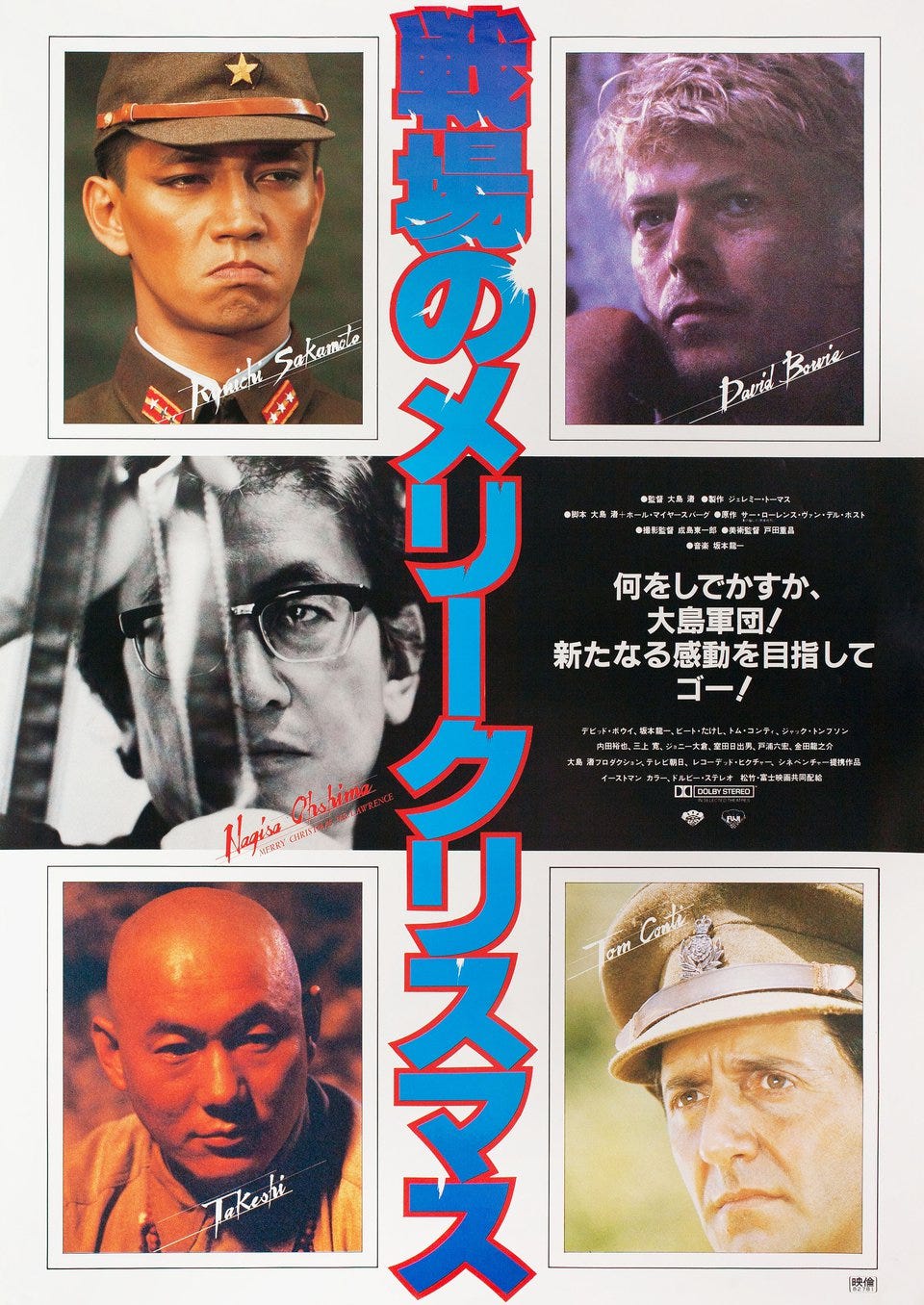
In “Merry Christmas, Mr. Lawrence,” Ryuichi Sakamoto takes on the role of Captain Yonoi, the commander of a Japanese prisoner of war camp in Java. He is a devotee of the Samurai Bushido code, which constantly places him at odds with both the POWs and his fellow soldiers – who he forces to commit seppuku (Japanese ritual suicide) on more than one occasion. Sakamoto proved to be a natural actor, though his onscreen intensity as Yonoi probably required very little acting – offering a window into the fiery artistic skirmishes that led to YMO’s abrupt disbandment.
The film bizarrely doesn’t feature the appearance of a single woman on screen – not even as an extra. This absence is best explained by the homosexual undertones that run throughout the film, especially in the relationship between Captain Yonoi and Bowie’s character, Major Jack (not Tom) Celliers. The titular Colonel John Lawrence, played by great thespian Tom Conti, is the film’s cultural – and emotional – buffer between the two as the only bilingual prisoner.
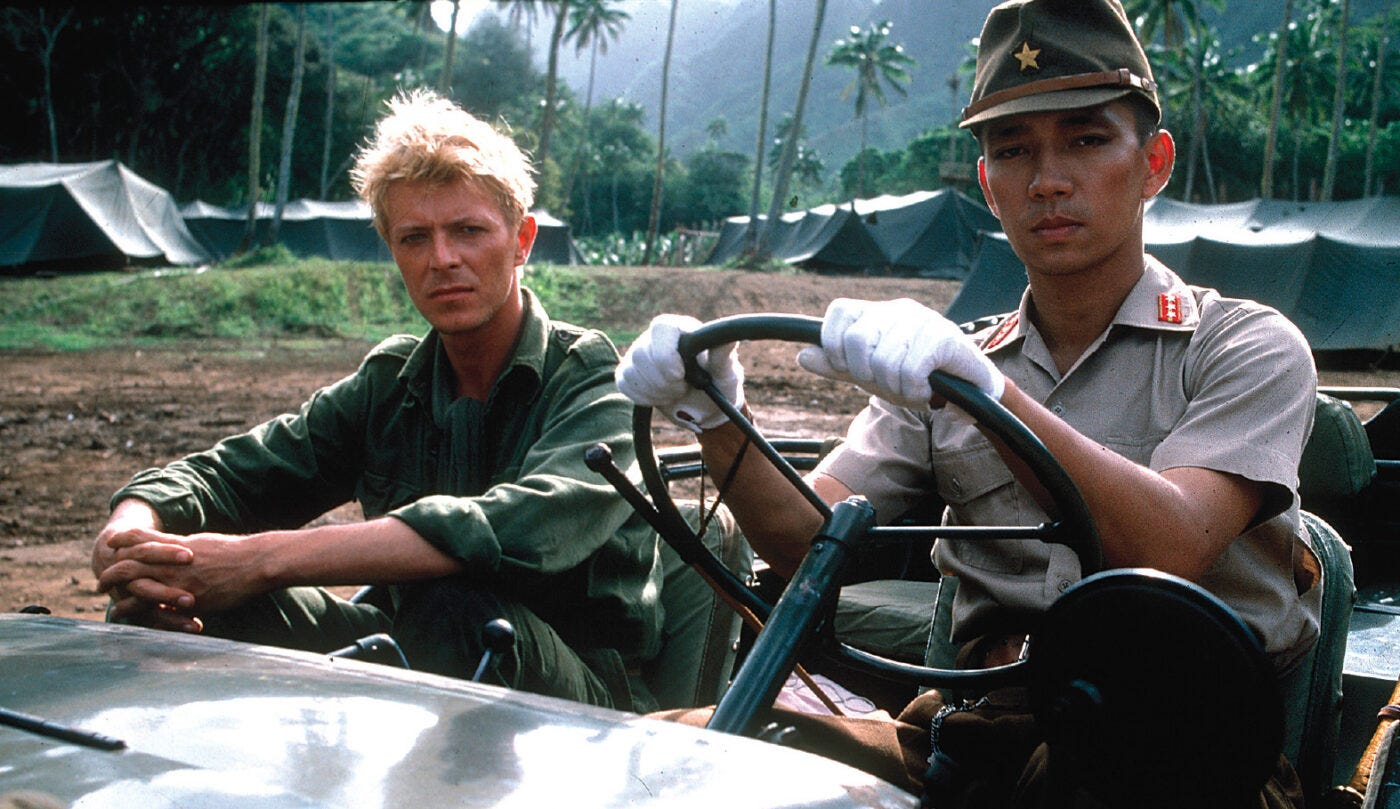
“Mr. Lawrence” shows great nuance for an aged war film. The cast of Japanese captors are as fully realized as their British prisoners; no one feels like a caricature. This is primarily a result of its unorthodox production team, with Japanese writers and directors, British producers, making a film based on the book “The Seed and the Sower,” by Afrikaner Laurens van der Post. This is most memorably presented in the final scene when Col. Lawrence remarks that while the Allies won officially, morally “we are all wrong.”17
Though “Merry Christmas, Mr. Lawrence” is only a small entry in Sakamoto’s long, illustrious career, the film is a compelling watch that show the immense cross-cultural respect that the composer draws. Furthermore, watching Bowie play a school-aged version of his character in a flashback – as the Starman was pushing forty – is an equally compelling reason to give the film a watch.
Success: East and West
The dual actor-composer role Sakamoto held allowed him to produce a score that captures the emotional weight of each and every scene in the film. In many ways, the majority of the compositions function as an elaborate diversion that makes the return to the theme at the film’s climatic moments so incredibly rewarding. The theme, “Merry Christmas, Mr. Lawrence,” shows the power of simplicity: its melody uses just five piano keys – written in the Asian pentatonic scale – and is repeated unremittingly for the song’s nearly five-minute runtime. The recording, as it appears in the film, has a mystical quality, achieved through its simple production. Sakamoto mixes electronic elements – a synthesized drumbeat, wispy keyboard, and strings – with acoustic piano. And for the main melody, he uses “Japanese” bells, which are, in actuality, the sampled sounds of a struck wine glass. The result is a song that forms a contradiction: light, airy, and ambient, yet affecting and solemn. The genius of “Mr. Lawrence” can hardly be attributed to any one element in particular, and even if it could, articulating such would be impossibly difficult. So instead of discussing what makes this piece great, we will focus on the reception and enduring legacy of Sakamoto’s most famous composition.
“Merry Christmas, Mr. Lawrence” (the film) was a modest success on its release internationally, owing to the box office draw of David Bowie – who had released what would become the best-selling album of his career, Let’s Dance, only months prior. In Japan, the film was understandably a much greater deal, with Sakamoto’s own domestic star power being as strong an attractor as Bowie’s. Also, the movie’s charitable depiction of Imperial Japan certainly didn’t hurt its performance in the nation. So, while “Mr. Lawrence” was by no means a commercial flop, it is extremely probable that Sakamoto’s theme is more recognizable today than the movie it was written for.
“Merry Christmas, Mr. Lawrence” (the song) saw dual success in the East and West in two quite different forms. Sakamoto’s instrumental version became a became a cultural touchstone in Japan and inextricably linked to the holiday season – despite the film being as much of a Christmas film as “Diehard.” The song is the Japanese equivalent of Wham’s “Last Christmas” or Mariah Carey’s “All I Want for Christmas Is You” and it can be expected to be heard blaring in public spaces for the length of December. This association with holiday commercialization particularly bizarre fate to befall Sakamoto’s neoclassical composition, though its sentimentality can plausibly conjure images of falling snow and roaring fires. The most popular version of “Mr. Lawrence” is not the original electronic rendition that appears in the film, but a 1996 re-recording for a piano, violin, and cello trio. The track has just over 100 million streams on Spotify at the time of writing, making it far and away Sakamoto’s most popular song.
In the West, the aforementioned vocal version of “Mr. Lawrence,” titled “Forbidden Colours,” saw considerable success, though not of the enduring kind like in Japan. As mentioned previously, Sakamoto brought in his friend David Sylvian to compose and perform the lyrics, making it the first project that the Japan frontman embarked on since his band’s official breakup the previous December. Adding vocals to a classical masterpiece is about as daunting a task as can befall a lyricist – and Sylvian expectedly rose to occasion. Instead of putting lyrics to the melody of “Mr. Lawrence,” which Sakamoto had expected, Sylvian composed his own countermelody, creating the impression of a song within a song.18 With this form, “Forbidden Colours” doesn’t disrupt the clarity of Sakamoto’s original composition but adds new color to this mostly empty, minimalist soundscape – it is neither better nor worse, just different. The lyrical subject matter is cryptic, but one repeated line: “my love wears forbidden colours,” is an intentional nod to the homosexual undertones permeating the film.
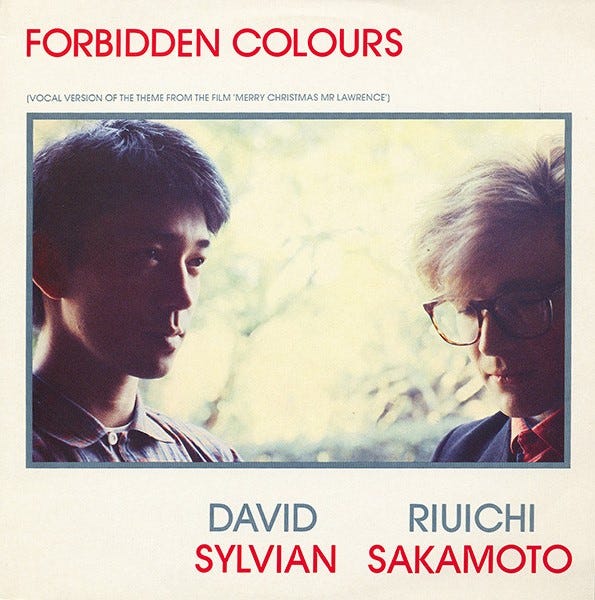
Although “Forbidden Colours” wasn’t a runaway hit in the UK, peaking at No. 16,19 – it did top the chart in Iceland20 – the track helped elevate “Mr. Lawrence” from obscurity into a state of limbo: not known to the masses but nonetheless impactful. This musical impact extends far beyond the neo-classical sphere. In an interesting, unexpected tidbit: the opening mandolin riff of alternative rock pioneers R.E.M.’s “Losing My Religion” turns out to have been a subconscious recreation of Sakamoto’s melody21 – which once you hear, you cannot unhear. A more overt tribute came in 1999 when German-Turkish DJ Quicksilver created a club remix of Sakamoto’s instrumental, titled “Heart of Asia,” that was a surprise hit across Europe, reaching No. 3 in the UK.22 Of course, the success of these tributes were fleeting, and today both the song and film can be classified as cult classics.
To Cut A Long Story Short
Ryuichi Sakamoto’s career following “Mr. Lawrence” cut across just about every musical realm. He continued to compose film scores, most notably “The Last Emperor,” for which Sakamoto won the Oscar for Best Original Score alongside Talking Heads frontman David Byrne, making him the first Japanese composer to receive this honor. He continued to experiment in far-flung genres, from Latin, ambient, and glitch music to composing cell phone ringtones for Nokia.23 Sakamoto refused to be pigeonholed, and yet, throughout all his reinventions and new collaborations, his artistic partnership with David Slyvian endured. Sakamoto and Sylvian were fixtures of each other’s albums, frequently trading roles as composer and vocalist.
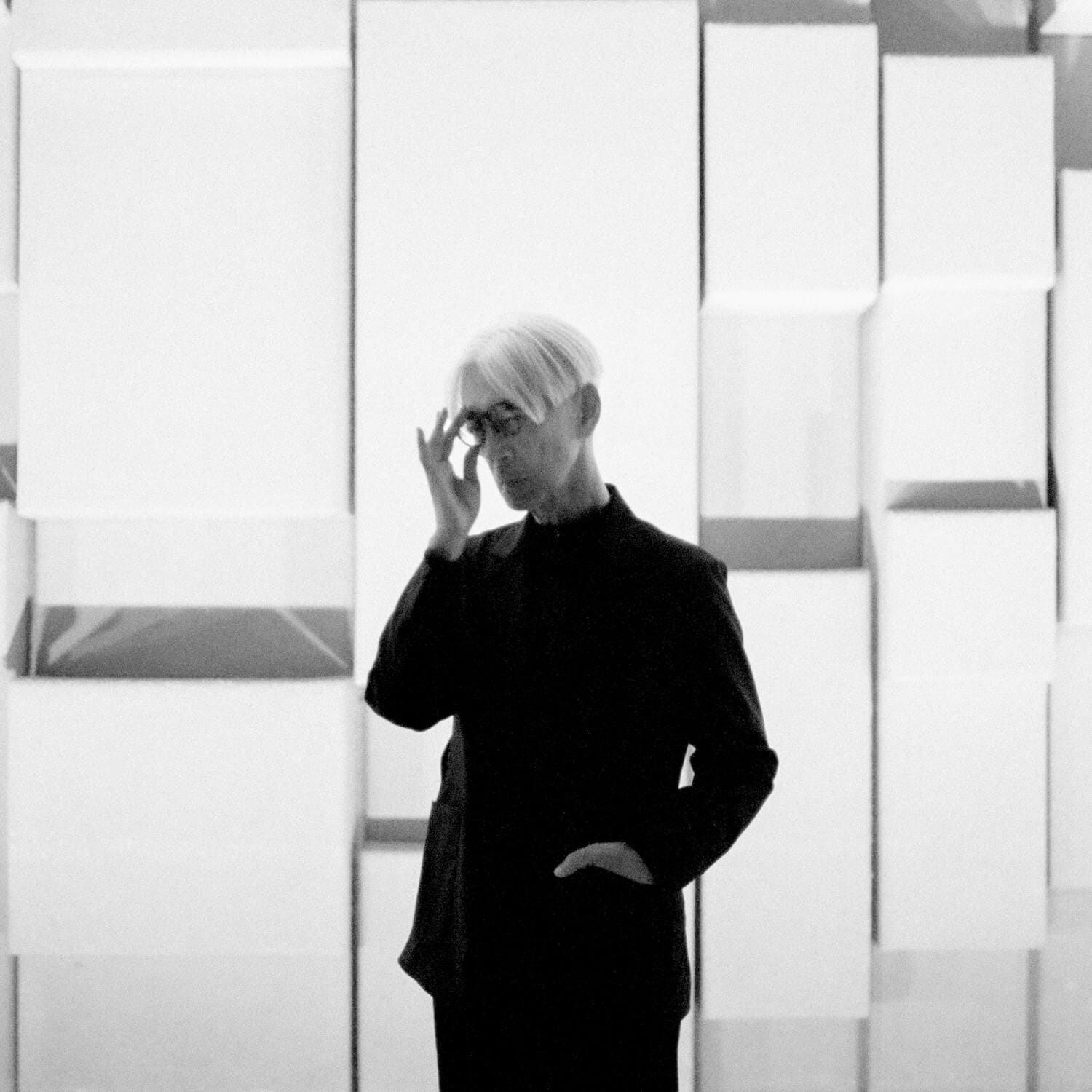
In 2022, Sylvian contributed a track to To The Moon And Back, a tribute album in celebration of Sakamoto’s 70th birthday. Just like “Forbidden Colours” four decades earlier, Sylvian created a lyrical countermelody to an existing Sakamoto instrumental, “Grains,” from his 2007 electronic album utp_.24 This track marked the first time Sylvian had sung in ten years. With his raw, aged performance, he offers a reflection on the life of a close friend that was fast approaching its end, a final goodbye: “Take the earth out of his mouth. And the boot from off his chest. There is nothing more to ask of him. He done better than his best.”25 Ryuichi Sakamoto passed three months later after a long battle with throat cancer at the age of 71.
David Sylvian and Ryuichi Sakamoto may not have been bound by geography, culture, or language, but they shared one fundamental attribute: a loathing of complacency. The two musicians had achieved great mainstream success at the time of their meeting, yet sustaining it, at the cost of their artistic vision, was of no interest to them. The duo spent the remainder of their careers creating what they wanted when they wanted, even if it had little no chance of yielding a financial return.
There is great honor in art for art’s sake. The life of Ryuichi Sakamoto embodied this principle to its fullest.
https://www.billboard.com/artist/Kraftwerk/chart-history/HSI
https://www.officialcharts.com/charts/singles-chart/19750601/7501/
http://www.powmag.net/p/whats-past-is-epilogue-the-thousand-knives-of-ryuichi-sakamoto
https://genius.com/Ryuichi-sakamoto-the-end-of-asia-lyrics
https://www.officialcharts.com/search/Computer%20Game%20(Theme%20From%20'the%20Invaders')/?artists=0&albums=0&films=0
https://www.billboard.com/artist/yellow-magic-orchestra/
https://medium.com/thsppl/the-best-6007f9499caf
https://jazzrocksoul.com/artists/yellow-magic-orchestra/
https://www.hiphopelectronic.com/no-daw-its-old-school-bangers/synthpop-songs-yellow-magic-orchestra-behind-the-mask
https://daily.redbullmusicacademy.com/2015/04/david-sylvian-and-japan
https://www.researchgate.net/publication/402377535_Visions_of_China_Avant-Orientalism_Art_Rock_and_Conflicted_Otherness
https://sylvianvista.com/2022/12/02/visions-of-china/
https://www.officialcharts.com/songs/japan-ghosts/
https://www.officialcharts.com/songs/vapors-turning-japanese/
https://www.officialcharts.com/songs/sylvian-sakamoto-bamboo-housesbamboo-music/
https://www.newyorker.com/culture/culture-desk/the-beautiful-unpredictable-life-of-ryuichi-sakamoto
https://www.artandpopularculture.com/Merry_Christmas_Mr._Lawrence
https://thequietus.com/interviews/strange-world-of/david-sylvian-interview/
https://www.officialcharts.com/songs/david-sylvian-and-riuichi-sakamoto-forbidden-colours/
https://timarit.is/page/2479308?iabr=on#page/n28/mode/1up
https://www.wsj.com/articles/behind-r-e-m-s-hit-losing-my-religion-1460479898
https://www.officialcharts.com/charts/singles-chart/20000507/7501/
https://crackmagazine.net/2023/04/listen-to-a-collection-nokia-ringtones-composed-by-ryuichi-sakamoto/
https://sylvianvista.com/2024/11/15/grains-sweet-paulownia-wood/#:~:text=To%20hear%20the%20singing%20voice,around%20January%2FFebruary%20of%202022.
https://readdork.com/lyrics/david-sylvian-grains-sweet-paulownia-wood-david-sylvian-remodel